how to use CHKDSK in windows PC

If your Windows 10 or Windows 11 PC suddenly becomes very slow, shows 100% disk usage in Task Manager, freezes for no reason, or displays errors like “Windows detected a hard disk problem”, there might be something wrong with the drive. In many cases, these issues are caused by disk or file system errors and sometimes by bad sectors on the hard drive or SSD. To deal with such situations, Windows includes a built‑in tool called Check Disk (CHKDSK) that can scan your drive for file system problems, find bad sectors, and, in many cases, fix disk errors automatically. In this guide, you’ll learn what CHKDSK is, when you should run it, and how to use it in Windows 11 and 10 (with both Command Prompt and File Explorer) to check the health of your disk and repair common drive errors.

What is CHKDSK (Check Disk) in Windows?

CHKDSK (short for Check Disk) is a command‑line utility built into Windows. As the name suggests, it checks the health of a disk and attempts to correct any errors it detects. (if possible)

CHKDSK can:

  • Verify the integrity of the file system (NTFS, FAT/FAT32, exFAT)
  • Detect and fix file system errors such as corrupt entries, cross‑linked files, and lost clusters
  • Locate bad sectors on the physical disk surface and mark them so Windows does not use them again
  • Help resolve issues like disk read errors, I/O errors, some blue screen errors (BSOD) and certain boot problems

In simple terms, CHKDSK helps identify and fix issues with the drive itself and how data is stored on it.

Important: CHKDSK can detect hardware problems, but it cannot fully repair a physically failing drive. Always keep backups of important data.

When Should You Run CHKDSK to Fix Disk Errors?

You should consider running CHKDSK in Windows 11 or 10 if you notice any of these symptoms:

  • 100% disk usage in Task Manager for long periods
  • Windows becomes unresponsive, especially when opening or saving files
  • Frequent messages such as “Windows detected a hard disk problem” or “A disk read error occurred”
  • Files or folders become corrupt or unreadable
  • Frequent blue screen errors mentioning disk or file system issues
  • Windows sometimes fails to boot or shows automatic repair screens
  • On mechanical hard drives (HDD), you hear clicking or grinding noises (in this case, back up your data immediately before running any repair)

You can also use CHKDSK as preventive maintenance, for example, every few months, especially on older HDDs, to catch problems early.

Tip: If your drive is very old, noisy, or already showing signs of failure, focus on back up your files first, then run CHKDSK to evaluate the disk condition.

Understand CHKDSK Command Syntax and Parameters

The basic CHKDSK command syntax looks like this:

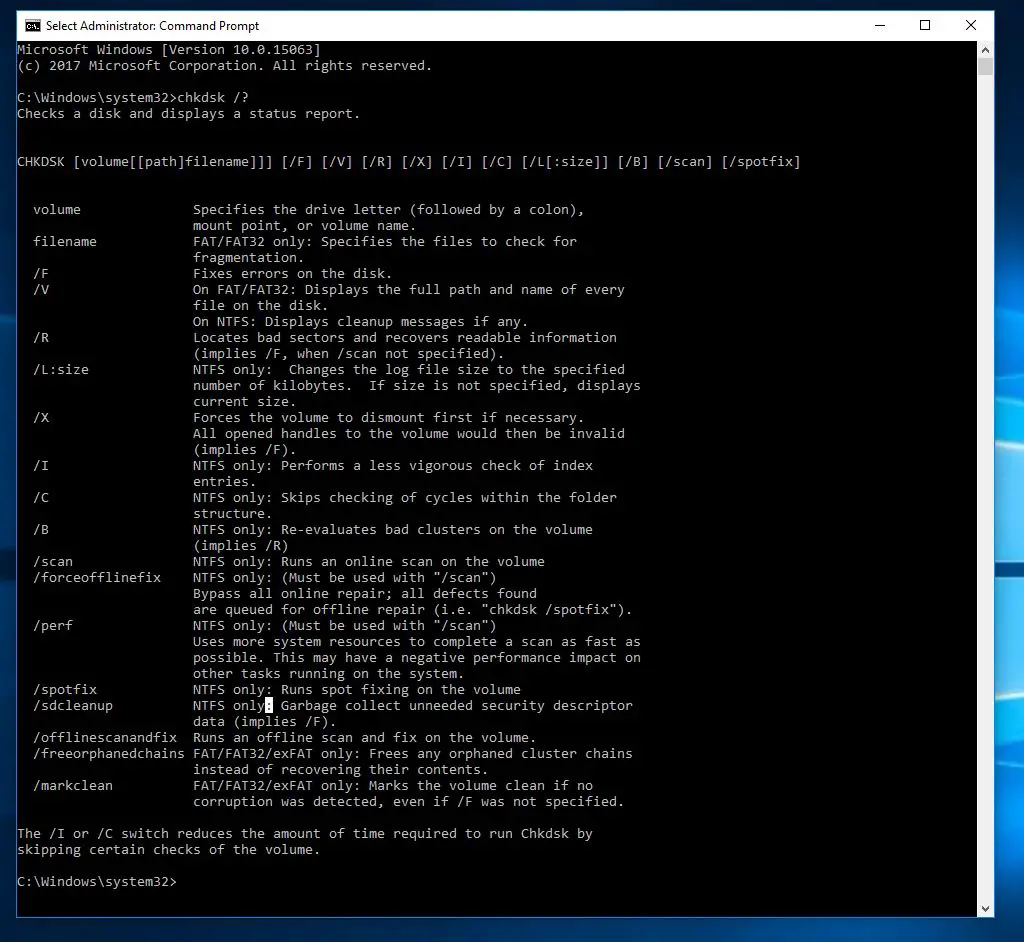
chkdsk [drive:] [/f] [/r] [/x]

check disk for errors windows 10
Where:

  • drive: – The drive letter you want to check (for example, C: or D:).
  • /f – Fixes detected file system errors on the disk.
  • /r – Locates bad sectors and recovers readable information (implies /f).
  • /x – Forces the volume to dismount before the scan; also implies /f.

Common CHKDSK parameters in Windows 10 and 11

Here are some useful switches you may use:

  • /f – Fixes errors on the disk. Use this when you want CHKDSK to actually repair problems.
  • /r – Locates bad sectors and attempts to recover readable information. Implies /f. This is a deep scan and can take a long time.
  • /x – Forces the volume to dismount first. On a system drive, CHKDSK will usually schedule the scan for the next restart instead.
  • /scan (NTFS, Windows 10/11) – Runs an online scan without requiring a restart.
  • /spotfix – Performs spot repairs on the file system in offline mode.
  • /offlinescanandfix – Schedules an offline scan and fix during the next restart.

To see all available options and what they do, run:

chkdsk /?

Windows will display the full list of parameters with short descriptions.


CHKDSK parameters

How to Run CHKDSK from Command Prompt (Windows 10 & 11)

Running CHKDSK from Command Prompt or Windows Terminal gives you full control and is the most powerful way to fix disk errors.

Open Command Prompt as Administrator

  1. Press Windows key + S, type cmd.
  2. In the search results, right‑click Command Prompt and choose Run as administrator.
  3. Click Yes when prompted by User Account Control.

You can also open Windows Terminal (Admin) and select Command Prompt or PowerShell as the profile. The CHKDSK commands are the same.

Run a Read‑Only CHKDSK Scan

If you want to check the disk status without making any changes, use a read‑only scan:

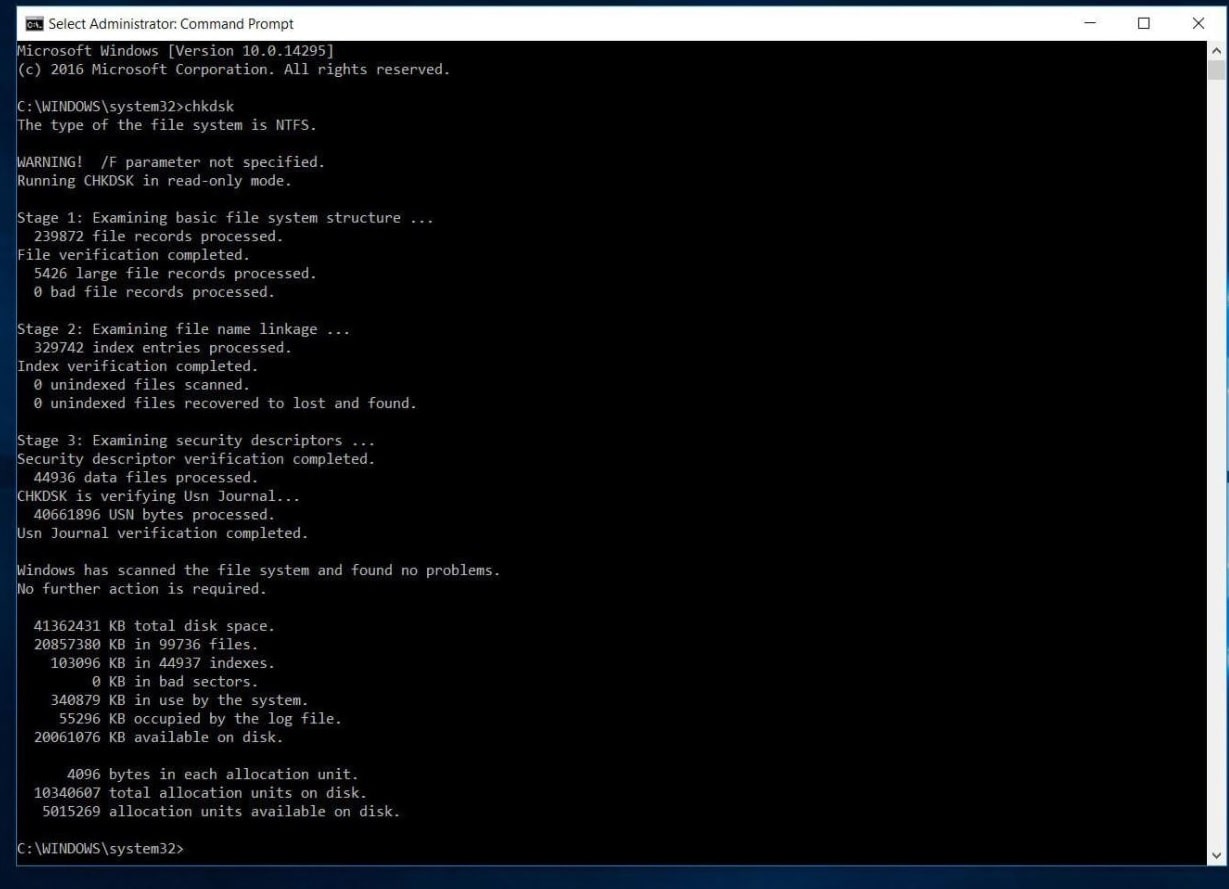
chkdsk
  • This checks the current drive (usually C:) for errors in read‑only mode.
  • It shows a summary of disk usage and whether any file system errors are detected.
  • It does not fix errors.

Run CHKDSK Command on Windows 10
This is useful if you just want to see if there are problems without risking changes yet.

Scan and Fix Disk Errors on the System Drive (C:)

To thoroughly scan the system drive (C:) and fix disk errors and bad sectors, use:

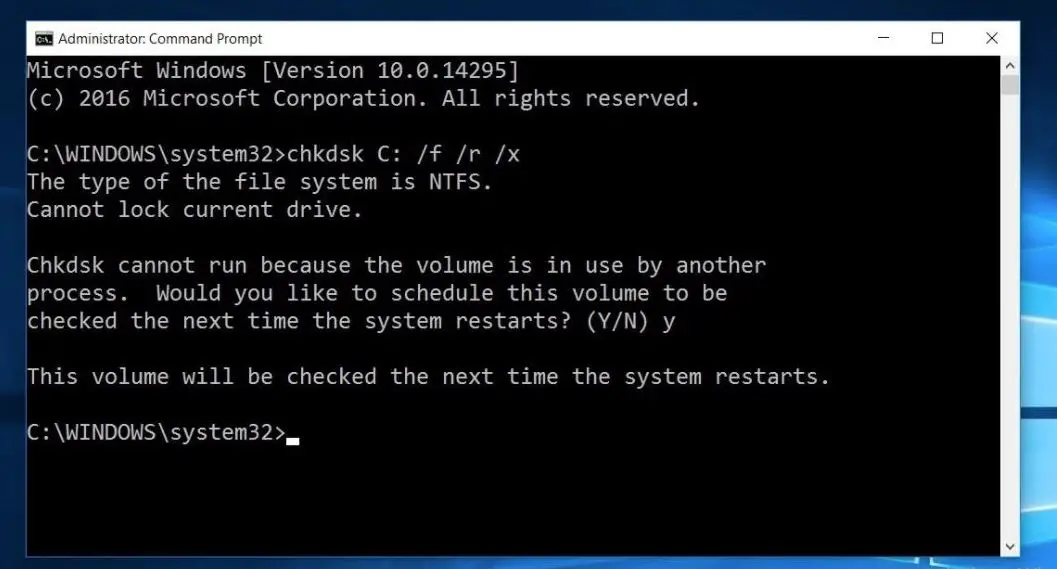
chkdsk C: /f /r /x

Explanation:

  • C: – The drive you want to check (change to D:, E:, etc. for other drives).
  • /f – Automatically fixes file system errors it finds.
  • /r – Locates bad sectors and recovers readable information; implies /f.
  • /x – Forces the volume to dismount first; implies /f. On the system drive, this usually means scheduling a scan on restart.

Because the C: drive is in use while Windows is running, CHKDSK cannot lock it. You will see a message like:

“CHKDSK cannot run because the volume is in use by another process. Would you like to schedule this volume to be checked the next time the system restarts? (Y/N)”

check disk errors

Type Y and press Enter, then restart your computer.

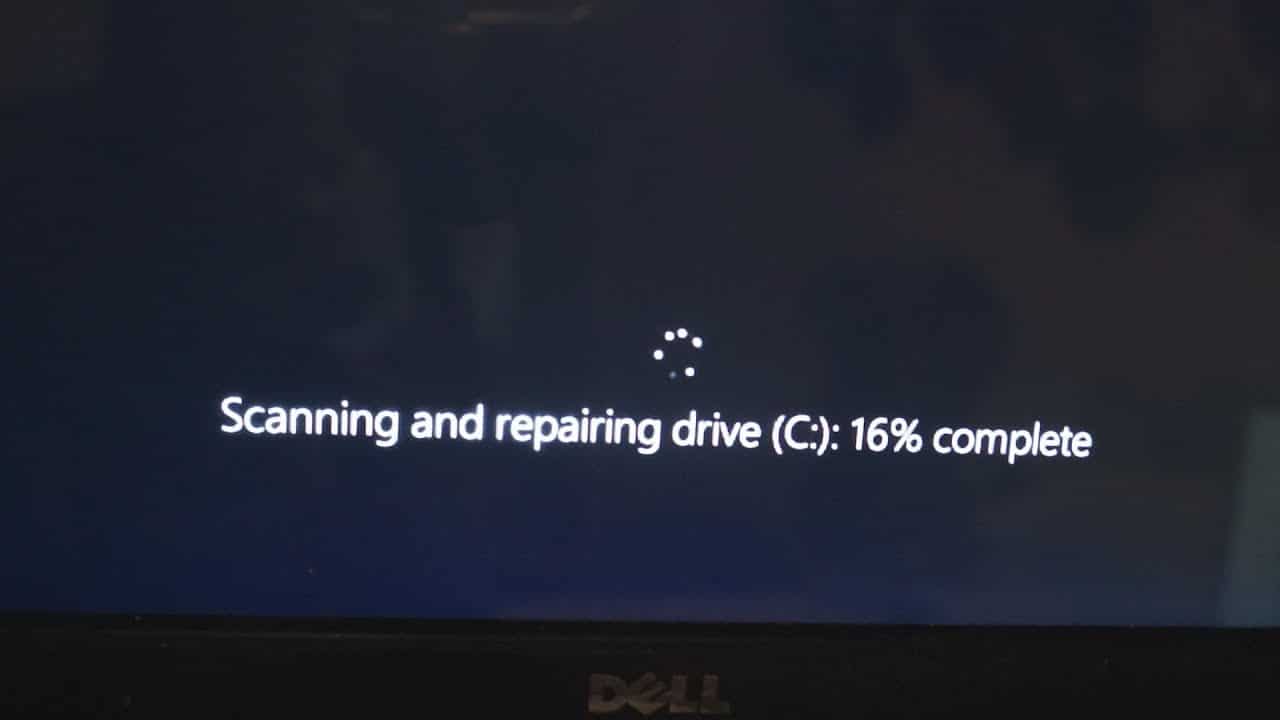
  • Before Windows starts, CHKDSK automatically scans the C: drive.
  • It will attempt to fix file system errors and mark bad sectors so they are no longer used.
  • This process can take from a few minutes to several hours, depending on disk size, speed, and the number of errors.

Let CHKDSK reach 100% and complete the scan. When it finishes, Windows will boot normally.

Fix Disk Errors with Check Disk Utility

Note: On laptops, keep the device plugged in during a long CHKDSK scan to avoid power loss.

Run CHKDSK on Non‑System Drives (D:, E:, external drives)

To scan a data drive or external drive, you can use the same syntax, for example:

chkdsk D: /f /r

If the drive isn’t in use by other programs, CHKDSK may start the scan and repair immediately without requiring a restart.

How to Run CHKDSK from File Explorer

If you don’t like command‑line tools, you can run CHKDSK using the Error checking feature in File Explorer. This method is easier for beginners and still helps fix many disk errors.

Check and Repair Drive Errors from File Explorer

  1. Press Windows key + E to open File Explorer.
  2. In the left pane, click This PC.
  3. Right‑click the drive you want to check (for example, Local Disk (C:)) and choose Properties.
  4. Go to the Tools tab. Under Error checking, click Check.

Check disk for errors

Windows will quickly check if the drive seems healthy. If it doesn’t detect obvious problems, you may see:

“You don’t need to scan this drive.”

You can still click Scan drive to run a manual scan.

  • If Windows finds file system errors, it may allow you to repair them.
  • For deeper or more complex errors (especially on the system drive), it may suggest running the repair during the next restart.

This GUI method is ideal for:

  • Beginner users
  • Quick checks on data drives
  • Cases where you don’t need the advanced /r bad‑sector scan

For serious problems, use the command‑line CHKDSK with /f /r as explained earlier.

How Often Should You Run CHKDSK?

There is no strict rule, but some practical advice:

  • Run CHKDSK when you see symptoms:

    • Disk errors or warnings in Windows 10/11
    • Frequent freezes, 100% disk usage, or file corruption
    • Windows offers to scan and repair the drive
  • For older HDDs, running a CHKDSK scan every few months can help catch problems early.

  • For SSDs, use CHKDSK mainly when you suspect real issues (don’t run /r repeatedly without reason).

Remember: If a drive shows repeated errors or bad sectors, prioritize data backup over endless scanning.

What If CHKDSK Finds Problems It Can’t Fix?

If CHKDSK reports that it found problems but could not fix them all, or you still see errors afterward:

  1. Back up your important files immediately, especially from that drive.
  2. Run CHKDSK again with /f /r to see if it can fix more issues.
  3. Check the drive’s SMART status using the manufacturer’s diagnostic tool or a third‑party utility.
  4. If SMART shows many reallocated, pending, or uncorrectable sectors, the drive is likely failing – plan to replace it soon.

If the drive seems healthy but Windows is still unstable:

  • Run SFC and DISM to repair system files and the Windows image.
  • Use System Restore to roll back to a previous working state.
  • As a last resort, use Reset this PC or perform a clean install of Windows 10 or 11.

CHKDSK vs SFC vs DISM – What’s the Difference?

Windows has three main built‑in tools that help with stability and repair:

  • CHKDSK – Works on the disk and file system (logical structure, bad sectors, disk errors).
  • SFC (System File Checker) – Scans and repairs Windows system files.
  • DISM (Deployment Image Servicing and Management) – Repairs the Windows system image/component store that SFC relies on.

They fix different layers of the system:

  • Use CHKDSK when you suspect disk or file system issues (disk errors, file corruption, 100% disk usage, I/O errors).
  • Use SFC when Windows components or system files are corrupted (missing DLLs, weird OS behavior, update failures).
  • Use DISM /RestoreHealth when SFC can’t fix files and the underlying system image might be corrupt.

Frequently Asked Questions About CHKDSK

Does CHKDSK delete my files?

Normally, no. CHKDSK repairs the file system structure and marks bad sectors; it does not intentionally delete personal files.

However, if files are stored in badly damaged sectors or are part of a corrupted structure, some data may become inaccessible during repairs. This is why you should back up important data before running CHKDSK with /f or /r on a problematic drive.

Is CHKDSK safe to run on an SSD?

Yes, CHKDSK is generally safe to run on SSDs. It checks the file system and marks bad sectors logically.

Just avoid running long, repeated /r scans without reason. Use /f or simple scans when you suspect real issues, and always keep a backup.

Can I use my PC while CHKDSK is running?

It depends on how you run it:

  • A simple online scan (for example, with /scan on NTFS) may allow limited use of the PC, though performance may drop.
  • When CHKDSK runs with /f /r on the system drive, it usually runs before Windows starts, so you cannot use the computer until the scan completes.
Steve Ballmer
With over 7 years of experience in the IT industry, I have experience in IT support, helpdesk, sysadmin, network admin, and cloud computing. Certified in Microsoft Technologies (MCTS and MCSA) and also Cisco Certified Professional in Routing and Switching.